
A useful paper budget answers one question at a glance: what is safe to spend?
One paycheck lands on Friday; the other arrives on the 15th. Meanwhile, the mortgage leaves a joint account, groceries come off a personal card, and the insurance bill is due before either spouse gets paid again. A monthly total alone cannot show whether there is enough cash today.
A useful planner separates scheduled bills from payments that have cleared and records which account pays each one. It also leaves room to mark transfers between spouses without counting the same money twice. The number worth checking is the amount left after upcoming bills and agreed savings—not the bank balance. That habit fits into a broader approach to managing marital finances.
Choose by the budgeting snag



Product descriptions show what each planner is meant to do, but not whether its pages will handle two incomes and several accounts. Sample interior layouts are more useful than a cover photo when judging that fit.
-
Inspect a monthly spread
Look for room to record each payday, the account paying each bill, due dates and payment status. Check whether shared expenses and personal spending can be tracked without confusing the available balance.
-
Check the physical format
Confirm listed dimensions rather than assuming a B5 label guarantees enough writing space. Compare binding styles, especially if the planner must lie flat for both partners to review it together.
-
Verify storage and cost
For the book advertised with twelve pockets, check whether pockets are attached securely and sized for the receipts or statements the couple keeps. Compare the current price with the layouts and features actually shown in the listing.
Listings alone cannot establish paper quality, binding durability or a verified page count.
Couples Budget Planner for Shared Money Conversations
01
Designed to help couples manage money as a team
This roughly $7 paper planner is positioned around managing household expenses and savings goals together. It suits a couple that wants a regular place to discuss bills, priorities, and progress toward a shared goal—not just record purchases after the fact. Its low listed price makes it an approachable starting point, provided the interior pages fit the way the household actually handles money.
- Shared bills and savings goals give monthly money talks a concrete agenda.
- The approximately $7 listed price keeps the initial commitment modest.
- A paper record can make agreed priorities easy for both partners to revisit.
- The couples label alone does not establish support for separate accounts or unequal bill contributions.
- The listing description does not confirm how the pages handle irregular pay or bills due between paydays.
Before buying, inspect sample monthly pages for a column identifying which account pays each bill, room to record each partner’s contribution, and a dated balance that shows what remains after upcoming commitments. For irregular income, look for space to enter actual pay dates and amounts rather than a single assumed monthly paycheck. If those fields are absent, the planner may still work for shared savings discussions, but the couple will need a separate ledger for day-to-day cash decisions.
SOLIGT Budget Planner for Monthly Bills and Receipts
Flexible monthly planning with pockets for bills and receipts
For couples who still receive paper bills or keep receipts, this undated SOLIGT book puts planning pages and document storage together. Assign one of its 12 pockets to each month: a paid-bill notice, a return receipt, and a statement can stay available until the couple checks them against account activity. The blank months also let a household begin in April or after a move without leaving unused dated pages at the front. Its pages provide space for income, expenses, savings, debts, and bills; the pockets hold the supporting paperwork.
- Twelve pockets can keep each month’s paperwork together for reconciliation.
- Undated, unassigned pages accommodate a midyear start and household-specific categories.
- Planning pages provide a place to record bills and expenses alongside the stored documents.
- A receipt in a pocket is not a transaction record; amounts and payment status still need to be entered and checked.
- Pockets filled with statements and receipts can make the book bulky.
And Per Se Budget Planner for a Shared Household Spot
Undated planning spans 16 months
At about $8, this undated A5 planner is a practical candidate for couples who keep their budget book in one place and pull it out for bill checks or weekly spending reviews. A hardcover makes sense in that routine: the book is handled repeatedly rather than carried everywhere. The listing describes 16 months of planning, with space for income, expenses, savings, debt, and bills.
- Hardcover format suits a planner that is handled often and stored in one household spot.
- Undated 16-month span allows couples to start whenever they are ready.
- Advertised tracking covers bills, savings, and debt alongside expenses.
- The number and size of expense-entry lines have not been verified; frequent purchases could require extra pages.
- A monthly calendar is advertised, but the layout has not been checked for recording bill status or which partner’s account pays.
- A5 pages may feel tight for two people’s notes, depending on the interior design.
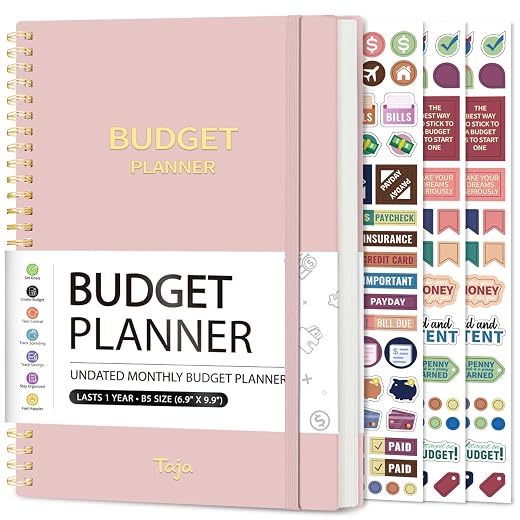
Taja Budget Planner for Couples Building a Recording Routine
Monthly pages cover goals, bills, savings, and debt
Taja’s undated planner suits couples who want a regular prompt to sit down with their numbers. One practical routine is to enter spending from both partners’ accounts once a week, then update bill, savings, and debt records together. Stickers can mark a completed check-in, but they cannot replace transaction entries that show what was spent and from which account. Before choosing this more segmented layout, couples should compare its tracked categories with their actual spending: if most purchases fall into “other,” the extra sections may add work rather than clarity.
- Undated monthly pages allow a couple to start at any point in the year.
- Separate bill, savings, and debt trackers give recurring check-ins a clear structure.
- At roughly $10, it is a relatively low-cost paper routine to try.
- Stickers and goal trackers do not establish a complete transaction ledger.
- Available details do not confirm how much space each month provides for individual expenses.
LOAPEM B5 Budget Planner for Detailed Expense Notes
Thick paper and spiral binding make writing convenient
This approximately $15 planner suits couples who need room to explain a number, not just record it. Beside a $120 grocery entry, for example, they might note that $35 covered supplies for a family gathering and agree how to split that portion. Its monthly budget and separate bill, debt, and savings trackers give those notes a place in a broader paper routine. Check an interior-page photo before buying: B5 dimensions do not establish how many transaction lines each page provides.
- The 7.3 × 10.15-inch B5 format gives handwriting and cost-split notes more room than a smaller planner.
- Spiral binding lays flat when both partners review a page; 100 GSM paper may reduce show-through.
- A waterproof PVC cover helps protect the book from everyday spills.
- The larger footprint takes more desk, bag, and shelf space than an A5 notebook.
- A waterproof cover does not make the paper pages waterproof.
- Tracker variety does not confirm a dedicated column for each partner’s share.
A paper planner needs one place to record what the household spent and, when accounts are separate, another to record who supplied the money. Otherwise, a transfer between spouses can look like a second expense.
- Pooled finances: Record income as it enters the shared account and each bill once when paid. No partner-contribution column is needed unless the couple wants to compare earnings.
- Separate accounts with shared bills: Keep a household bill list alongside a contribution ledger. If the mortgage is $2,400, enter one $2,400 housing expense, then note that one spouse supplied $1,400 and the other $1,000. A reimbursement or transfer to the bill-paying spouse belongs in the contribution ledger, not the expense total.
- Hybrid finances: Track shared bills and contributions as above, but keep personal spending in separate columns or pages. A transfer into the joint account is funding, not household income earned again; the mortgage remains one expense when the joint account pays it.
Treat sinking funds as money reserved for expected costs, such as property tax or car repairs. A $150 monthly set-aside is a movement into the fund, not a $150 repair expense; record the repair when it happens, noting which fund paid for it. Keep that balance separate from emergency savings, which covers unplanned shocks rather than predictable bills. Couples deciding how much to hold for surprises can use a separate emergency fund goal instead of treating every savings balance as available for routine costs.
Try the planner for one week
-
Enter paychecks as they arrive
Each spouse records take-home pay, expected pay date, and receiving account. Variable income should use a conservative amount for planning; any extra can be assigned after the deposit clears.
-
Put bills in due-date order
List each bill’s amount, due date, payment account, and whether it is automatic. For planning around mismatched paydays, flag any bill due before the next deposit: a bill due on the 12th cannot rely on a paycheck arriving on the 15th. Check that the earlier paycheck leaves enough in the paying account.
-
Separate shared and personal spending
Set shared categories for groceries, housing, and household costs, then give each spouse a personal spending line. Agree whether personal purchases come from separate accounts or the shared account so the ledger reflects actual cash movement.
-
Assign the recording work
Decide who logs card purchases and cash expenses, how soon entries are made, and who checks them against bank activity. Mark pending transactions so neither spouse mistakes an uncleared payment for available money.
-
Run an ordinary-week trial
Record seven days without changing spending habits, then reconcile every account used. If entries spill into margins or either spouse cannot tell what remains available before payday, adjust the categories or choose a roomier layout before committing to the book.
Frequently asked questions
Paper gives both partners a simple, shared view of bills, pay dates and spending, and makes it easy to see at a glance what is safe to spend.
Pay dates, bill due dates, which account each bill comes from, and spending by card, so you can see whether there is enough cash today, not just this month.
Hold a regular money meeting, such as weekly, to reconcile bank and card balances against the pages and adjust next month's plan.
For couples whose main obstacle is agreeing on shared expenses and savings, start with the Shared Finance Planner for Couples and Savings. If receipts and bill notices go missing, choose the Undated Budget Book with Twelve Storage Pockets instead. If transactions need more room, the B5 Budget Planner with Durable Waterproof Cover is the stronger candidate.
Check sample pages together before buying: confirm there is space for each payday, account balances, and the entries both partners will actually record. Buy one planner, then set a recurring monthly money meeting to review it. Reconcile bank and card balances against the pages, resolve missing entries, and adjust next month’s bill and spending plan.